Recursion
A method of solving problems where a function calls itself directly or indirectly.
Operations & Variations
Core Concepts
What is Recursion?
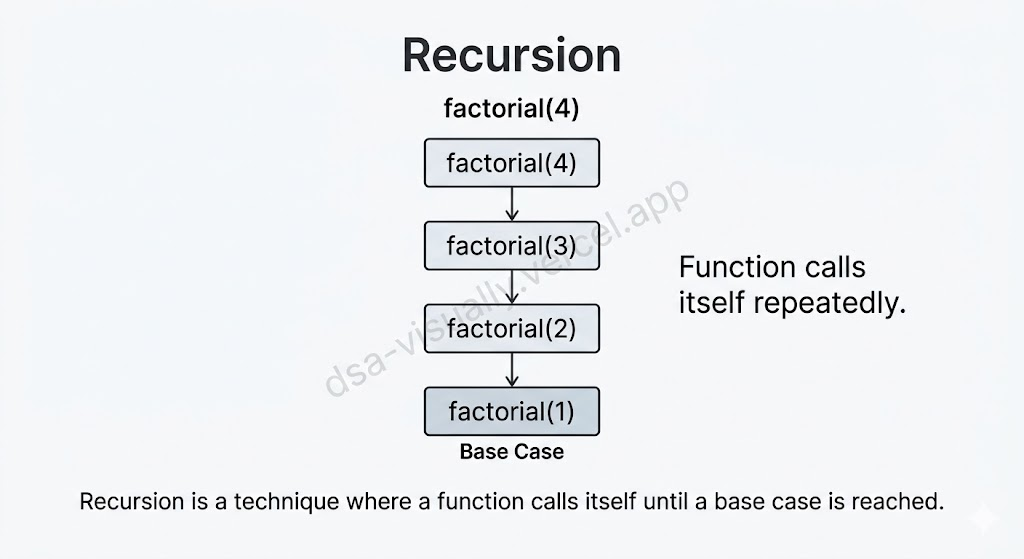
Recursion is a programming technique where a function calls itself, directly or indirectly, to solve a problem. It works by breaking down a complex problem into smaller, more manageable sub-problems of the same type.
Think of it like nested Russian Dolls (Matryoshka): inside a large doll is a slightly smaller doll, which contains another smaller doll, until you reach the smallest doll that cannot be opened.
Anatomy of a Recursive Function
Every valid recursive function must have two essential components:
1. The Base Case (The Stop Condition)
The condition under which the function stops calling itself. Without a proper base case, the function will call itself infinitely, leading to a critical Stack Overflow error where the application runs out of stack memory.
2. The Recursive Case (The Step)
The part of the function where it makes the recursive call, passing a reduced or modified input that actively moves closer toward the base case condition.
void recursiveFunction(int input) {
    // 1. Base Case
    if (input <= 0) {
        return;
    }

    // 2. Recursive Case (with reduced input)
    recursiveFunction(input - 1);
}
Memory Layout: The Call Stack
When a function executes, the computer suspends the caller and creates an Activation Record (Stack Frame) on the Call Stack containing parameter arguments, local variables, and the return address.
- Winding Phase: Recursive calls are made, pushing new frames onto the Call Stack and allocating memory.
- Unwinding Phase: Once the base case is triggered, the functions return values, frames are popped off the Call Stack, and memory is reclaimed.
Recursion vs Iteration
| Feature | Recursion | Iteration |
|---|---|---|
| Approach | Uses function self-calls | Uses loop constructs (for, while) |
| State | Kept in Stack Frames | Kept in local loop variables |
| Memory | High overhead (O(N) stack space) | Low overhead (O(1) extra space) |
| Speed | Marginally slower due to function calls | Faster direct execution |
| Code Elegance | Extremely clean for tree/graph structures | Can become complex and verbose |