Strings
A sequence of characters, usually terminated by a null character in C or stored as an object in C++.
Operations & Variations
Concatenation
EasyVisualize how two strings are appended together in memory.
Substring
EasyExtract a continuous portion of a string.
Reverse String
EasyVisualize reversing a string in place using two pointers.
Palindrome Check
EasyVisualize checking if a string reads the same forwards and backwards.
Pattern Matching
MediumFind occurrences of a pattern within a text string.
Core Concepts
What is a String?
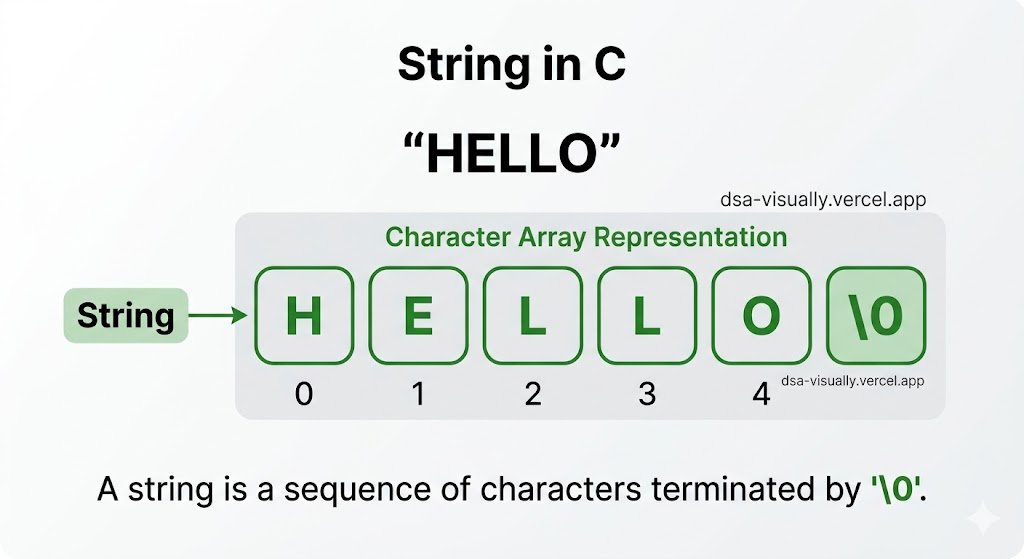
A String is a sequence of characters, primarily used to represent text. Under the hood, a string is generally implemented as an array of characters. It is one of the most widely used data structures across all programming domains, from basic standard output to complex text-processing algorithms.
Memory Layout
In C, a string is stored as a contiguous array of characters, ending with a special null-terminator character ('\0'). This terminator lets functions know where the string ends.
Index:   [ 0 ][ 1 ][ 2 ][ 3 ][ 4 ][ 5 ]
Char:    [ H ][ e ][ l ][ l ][ o ]['\0' ]
Address: [100][101][102][103][104][105]   (1 byte per char)
In modern high-level languages like C++, Java, and Python, strings are often implemented as objects. These objects manage the underlying character array dynamically, keeping track of the string's length without needing a null-terminator, and providing safety against buffer overflows.
Core Operations & Time Complexities
| Operation | Time Complexity | Notes |
|---|---|---|
| Access by index | O(1) | Like an array, direct access to the character |
| Search (Naive) | O(N * M) | N=text length, M=pattern length |
| Search (Optimized) | O(N + M) | KMP or Rabin-Karp algorithms |
| Concatenation | O(N + M) | Copying both strings into a new one |
| Substring | O(K) | Extracting K characters |
| Length | O(1) or O(N) | O(1) in C++/Java (stored), O(N) in C (counted) |
Space Complexity: O(N) — proportional to the number of characters.
Mutability
A critical concept with strings is mutability.
1. Mutable Strings
In C and C++, strings can be modified in place. Changing a character does not require allocating new memory.
std::string s = "hello";
s[0] = 'H'; // String is now "Hello"
2. Immutable Strings
In languages like Java, Python, and JavaScript, strings are immutable. Once created, a string's content cannot be changed. Operations like concatenation or replacing characters create entirely new string objects in memory.
String s = "hello";
s = s.toUpperCase(); // Creates a new string "HELLO"
Immutability provides security and thread-safety but can lead to performance overhead if many string manipulations are performed in a loop (which is why classes like StringBuilder exist).
Key Algorithmic Patterns
Mastering strings involves many of the same patterns as arrays, plus some text-specific ones:
Two Pointers
Used for problems like reversing a string or checking if a string is a palindrome.
Example: Checking if a string reads the same forwards and backwards.
Sliding Window
Ideal for finding substrings that meet certain criteria.
Example: Longest substring without repeating characters.
Hashing / Frequency Counting
Using a hash map or an array of size 256 (or 26 for alphabets) to count character occurrences.
Example: Checking if two strings are anagrams of each other.
Tries (Prefix Trees)
A specialized tree structure used for fast string retrieval and prefix matching.
Example: Autocomplete systems or spell checkers.
Advanced String Algorithms
When performance is critical, specialized algorithms are used for pattern matching:
- Knuth-Morris-Pratt (KMP): Uses a prefix table (LPS) to avoid redundant comparisons, finding a pattern in O(N + M).
- Rabin-Karp: Uses a rolling hash function to quickly eliminate non-matching substrings.
- Z Algorithm: Finds all occurrences of a pattern by constructing a Z-array in O(N + M) time.
Real-World Applications
- Text Processing & Compilers: Parsing code, spell checking, and formatting.
- Search Engines & Databases: Indexing keywords and performing fast text searches.
- Bioinformatics: DNA sequencing heavily relies on string matching algorithms to find genetic patterns (A, C, G, T).
- Data Serialization: Formats like JSON, XML, and HTML are entirely string-based and require efficient parsing.
- Cryptography: Encrypting and decrypting data involves complex string and byte-array manipulations.
Interview Tips 💡
- Ask about the character set — is it just lowercase English letters (a-z)? ASCII? Unicode? This determines if you can use a fixed-size array (like
int count[26]) for frequency counting. - Watch out for immutability. If you are building a string dynamically in a loop in Java/Python, use a
StringBuilderor a list to avoid O(N²) time complexity from repeated copying. - Empty strings (
"") andnullvalues are common edge cases. Always handle them first! - For anagram problems, sorting strings takes O(N log N), but frequency counting takes O(N) time and O(1) space.